
Artificial Scarcity, AI, and the Future of Legal Education: Lessons from Nyay and EduCulture

In 2013, with two very young children I asked my spiritual mentor if he had any parenting advise. He smiled, “Samirji, the biggest challenge of your generation is providing artificial scarcity to your children.” I did not fully get him then, but over the years this has proven to be the best parenting tip.

Every previous generation had scarcity built into the world for free. Information was hard to get, attention had to be earned through effort. A child who wanted an answer had to go to a library, ask an elder, or sit with the discomfort of not knowing for a while. Today’s children inherited a world where every answer, every distraction, every shortcut is just one tap away. If we want our children to develop a mind capable of depth, we have to manufacture the very friction that used to come built into life itself.

My sons are going to be 15 and 17 soon, and neither of them have owned a mobile phone as yet, but both are deeply respected by their friends and teachers for the depth of their understanding and the maturity they bring to a conversation. They use AI to explore new concepts, and parents’ phones for calls and to look at social media, and do both with a level of awareness that came directly from years of artificially engineered scarcity before any of these tools entered their hands.

Norway’s Prime Minister Jonas Gahr Støre announced on June 19, 2026 that hashtagGenerativeAI tools would be barred from classrooms for children aged 6 to 13, citing the risk of hashtagCognitiveOffloading, where children outsource effortful thinking to a tool rather than building the capacity themselves. The scientific principle behind this concern is called Desirable Difficulty, the finding that learning tasks requiring real effort produce far stronger long-term retention than tasks that feel easy in the moment. One of history’s most rigorous developed economies just legislated, by force of law, a principle my mentor handed me over a decade ago in a single sentence!

This is precisely the territory of hashtagNyay. The word carries two meanings in our tradition, and both are relevant here. Nyay is one of the six classical schools of hashtagIndianPhilosophy, built entirely around the discipline of rigorous hashtagLogicalReasoning, of refusing an easy conclusion until it has been tested, argued, and earned. Nyay is also the everyday word for hashtagJustice. The ancient guru-shishya tradition operated on exactly the desirable difficulty Norway has now written into policy. A shishya wrestled with a question under a guru’s relentless questioning rather than being handed the answer, because the wrestling itself was the curriculum.

hashtagEduCulture‘s argument is simply that we do not need to wait for Norway’s parliament to tell us what our own civilisational pedagogy already knew. We need parents, teachers, and policymakers willing to provide their children the artificial scarcity the modern world no longer provides for free. Question of AI era is how should our hashtagLegalEducation handle hashtagDesiredDifficulty?

Raising Rooted Children in the Age of AI: Why Vedantic Self-Knowledge Matters More Than Ever

Every week, I sit with my two teenage sons and we go through the hashtagBhagavadGita together, more than religious instruction for philosophical training. I want them equipped with the deepest Vedantic concepts our civilisation has produced before they fly off the nest for higher studies, because I suspect the world they are flying into will ask them “who are you” with a force and frequency I never faced at their age.

I do not know how hashtagAI is going to change everything. What I do know is what I am trying to do with whatever time and capability I have. Build my sons’ arsenal of self-knowledge deep enough that nothing can hollow out their sense of who they are. And in parallel, become more deliberately involved in questions of culture and identity myself, so that this extraordinarily powerful technology gets pointed, even in some small way, toward making the world better for them.

Here is the elephant in the room, named directly. We are at real risk of AI quietly homogenising human culture. A model trained mostly on English-language internet data does not just answer in English. It begins to think in the assumptions, the references, the aesthetic instincts of whoever produced the most text online. Without deliberate correction, “global AI” risks becoming, by sheer statistical gravity, a culturally narrow AI wearing a universal costume. A child anywhere on earth could grow up asking an AI about identity and receive an answer rootless to their own soil.

There is a second risk, say if a teenager can ask an AI about the hashtagGita instead of sitting weekly with a parent who has wrestled with it personally, something in the chain of transmission breaks, even if the algorithm’s answer is technically correct.

And underneath both risks lies the deepest one, that if AI becomes capable enough at everything, will an entire generation simply stop asking who they are at all, because the question stops feeling necessary?

I do not think the answer is rejecting the technology because the tool itself is not the problem. The question is what steers it. There are already real examples of AI pointed in the right direction. The Cherokee Nation partnered with Microsoft to build an AI-powered Cherokee keyboard and text-to-speech tools, now used in tribal schools where fewer than 2,000 fluent speakers remain. Manx, a Celtic language UNESCO had declared extinct, is being taught to children again and now available inside major translation platforms. Meta’s No Language Left Behind project built translation models for over 50 African languages. In each of these cases, the technology became a life raft for the culture to keep speaking in its own voice, to its own children, on its own terms.

My sons will leave home soon enough. I cannot control what AI becomes in the years they are away from home. What I can control is whether they leave carrying a hashtagVedantic arsenal substantial enough to ask better questions than the ones any model hands them by default.

Cultural Clusters: The Missing Link Between Education, Culture, and Economic Development

I learnt a new term last week. Cultural Cluster.

It came up in a conversation with friends far more fluent in the art world than I am, while we were discussing the idea of organising a Conclave on EduCulture. They used the term as part of their regular lexicon, so not formally knowing about it stood out even more. So I did what I usually do. I went and read, and realized that I had never properly defined it for myself, despite having built an entire framework around ideas surrounding this concept.

There are at least three serious definitions floating around. Urban economists define a cultural cluster as a geographic concentration of cultural and creative industries, generating what they call agglomeration benefits, shared labour pools, supply chains, and knowledge spillover between neighbours in the same trade. Think of a ‘film city’ where editors, sound engineers, and writers all live within a few kilometres of each other and informally train one another simply by proximity.

Heritage institutions define it differently. To them, a cultural cluster is a grouping of tangible and intangible heritage assets, monuments, crafts, performance traditions, treated as a single conservation and economic unit rather than scattered, disconnected sites competing for the same tourist’s attention.

Policy bodies define it as a third thing entirely. A deliberately designed zone, government-backed, that fuses production, education, tourism, and retail around a single cultural identity, built on purpose rather than emerging by accident.

Basis these best is to define cultural cluster as a bounded geography where heritage assets, creative production, skill transmission, and economic activity reinforce each other in a closed loop, designed or organic, dense enough that proximity itself becomes the value driver.

To me this is also a description of how hashtagEduCulture has to be implemented if it is going to mean anything beyond a LinkedIn post or a classroom discussion. We need a destination where it is lived, practised, and economically sustained. And, travel and tourism become the implementation tool. hashtagCulturalClusters become the natural destination tourism organises itself around.

This is where a half-formed idea I have been mulling over suddenly found its proper name. India needs a TravelTech hub. A geography where travel-tech startups, heritage tourism operators, craft economy ventures and aviation infrastructure sit close enough to feed each other the way a cultural cluster’s theory predicts. hashtagNewNoida, with a brand-new international airport at its doorstep and an entire investment region being built from scratch, may be the most logical place in the country for exactly that cluster to form.

I am testing this idea out loud, not announcing it as finished. If you know this space, urban planning, travel tech, cultural economy research, I would value your inputs immensely.

From “Kya Banoge?” to “Kya-Kya Banoge?”: Rethinking Education, Skills, and Lifelong Learning

“Bade hokar kya banoge?” (What will you become when you grow up?) Almost every Indian child has been asked this question, framed as a single destination, a final answer, a finish line. I have never asked this to my kids. I ask “kya-kya banoge?” instead. What all. Not a single destination, but continuous, ongoing accumulation of capability.

Between 2021 and 2025, China’s higher education institutions revoked or suspended over 12,000 undergraduate degree programmes while introducing more than 10,200 new ones. China looked at its own degree factory and decided the factory itself needed rebuilding, not just its output.

Germany solved this decades before AI made it urgent. Germany’s dual system of vocational training consists of about 1.2 million apprentices and around 400,000 training companies. In 2021, about 74 percent of all apprentices received an employment contract after completing their training at the same company. A vocational certificate in Germany carries the same social dignity as a university degree. Nobody whispers about the apprentice the way too many Indian families still whisper about the child who chose a trade over a college seat.

India inherited something similar once. The shreni, our ancient guild system, fused craft, livelihood, ethics and community into a single transmission, master to apprentice, skill to character, simultaneously. We severed that thread when we imported a purely degree-based industrial model from elsewhere and forgot to ask whether it fit the soil it landed on.

The paradigm has shifted, and the world has already moved. hashtagEducationhashtagSkillinghashtagCertification. Not a single credential earned once at twenty-two, but a continuous, layered, lifelong practice of capability mapped against transferable skills, the kind of mapping exercise I have run personally while preparing executive skill-lever frameworks for institutional roles, translating decades of varied experience into language a hiring committee can actually use.

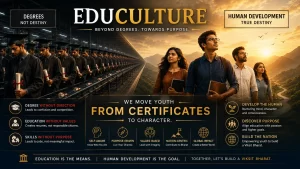
hashtagEduCulture‘s argument here is that the shreni model never separated skill from character, and Germany’s dual system never separated classroom from workplace. India’s emerging paradigm has to re-fuse both separations at once, treating continuous skilling as seriously as we once treated a single degree, and treating a craftsperson’s certification with the same dignity as a university gold medal.

Students, stop chasing the single answer to “what will you become.” Start building the portfolio of answers to “what all can you do.” Employers, the candidate who skills continuously will outperform the one who stopped learning the day they graduated. Policymakers, China has shown that the courage to dismantle an outdated credential system is now a competitive necessity, not an academic luxury.

The grammar of “kya-kya” instead of “kya” is small, but the shift in nation-building it points toward is immense.

Speed, Truth, and the Architecture of Civilisations

In 2020, I was designing NDMS, the pan-India cloud-based news gathering system for Akashvani and Doordarshan. One decision point became central to the entire architecture, “Should machine translation auto-publish news across India’s regional languages, or should every single item pass through a human Information Services Officer first?”

Speed argued for automation. The risk of fake news insertion, rapid propagation across regional languages, and translation errors that could distort meaning in ways no algorithm would catch, argued otherwise. I chose authentication over speed and built NDMS where every news item is manually verified before it reaches a citizen in any of India’s languages.

That was a small decision inside a government system. But the same choice seems central to our entire civilisation, at infinitely larger scale, with infinitely higher stakes.

And here not just Jobs, but lives are at stake. In November 2024, Suchir Balaji, a 26-year-old former OpenAI researcher who had gone public with concerns that the company broke copyright law to train its AI, was found dead in his San Francisco apartment. His parents have disavowed the conclusion of authorities and have publicly stated, repeatedly and on record, their belief that their son was killed for what he knew. They have filed a wrongful death lawsuit alleging tampering with surveillance footage and obstruction of the investigation. Sam Altman, when asked, said it looked like a suicide to him.

What I want to name here is the civilisational moment it represents. A whistleblower raised concerns about how a powerful technology company built its product. He died a month later. His own parents do not believe the official story. And the public conversation moved on within weeks, because the technology kept shipping regardless.

The Bhagavad Gita’s sixteenth chapter offers a framework I am developing further in my upcoming work. It describes two inherited natures in every person and every institution. Daivik Sampada, the divine qualities of truthfulness, restraint, and fearlessness in service of what is right. Asurik Sampada, the demonic qualities of hypocrisy, arrogance, and the pursuit of power without conscience. And civilisations, like a person, become whatever nature it consistently chooses under pressure.

A technological civilisation built entirely on Asurik Sampada optimises for speed, scale, and shareholder value, and treats truth, dignity, and human life as variables to be managed around. A technological civilisation built on Daivik Sampada asks a harder, slower question before every deployment. What does this do to a human being’s capacity to trust, to know what is real, to remain safe?

My NDMS decision was small but the principle inside it was not. Choose Daivik Sampada at the architecture level, before the product ships, or inherit Asurik Sampada’s consequences after it does. What does your organisation choose when speed and truth compete for the same deadline?

Indigenous Design: How Local Traditions Can Shape Global Innovation

My Director and DoP called sounding destroyed that the shoot in Darbhanga and Nepal had collapsed. They advised strongly to shut production down, walk away and cut losses.

I trusted my gut and asked the team to carry on, and ‘Mithila Makhaan’ became the first Maithili film in over 50 years of film making in the language to win a National Film Award.

The story was deceptively simple. Our protagonist Kranti returns from Canada to revive his grandfather’s Makhana cultivation. A parallel track follows a woman fighting to bring Madhubani painting back into a living economy. Two characters. One argument. Local craft, rooted identity, and entrepreneurial courage are worth more than a distant and foreign career.

That film was, at its heart, a design story.

Steve Jobs, in his 2005 Stanford address, described how a calligraphy class at Reed College shaped everything. He learned about typefaces, letter spacing, what makes typography great. He called it “beautiful, historical, artistically subtle in a way that science can’t capture.” Ten years later, every lesson went into the Macintosh, the first computer with beautiful typography, thereby an art class built a trillion-dollar company.

When I lived in Tokyo for over two years, I watched Japan do this at civilisational scale. Traditional craft aesthetics became industrial competitive advantage. The minimalism of Zen became Sony and Muji. Japan understood that art and industry are one conversation conducted across different time horizons.

India has Madhubani, Warli, Kalamkari, temple geometry that anticipates fractal mathematics. And design education largely stripped of this inheritance, training students in aesthetic vocabularies borrowed wholesale from elsewhere. We export raw craft. We import designed products. We buy back at a premium what our hands originally created.

EduCulture says design education in India has to begin at this point, in the village, in the craft, in the living tradition before it reaches the studio. Kranti in Mithila Makhaan chose his grandfather’s farm over Toronto. Steve Jobs chose a calligraphy class over a conventional degree. Both were design decisions before they were anything else.

We all need to explore what indigenous design vocabulary we are sitting on and need to go deep enough into it to build something the world has never seen.

Why Character Matters More Than Intelligence in the Age of AI

What struck me most when I started living at Indian Institute of Technology, Kharagpur campus was the sheer density of raw intelligence all around me. One kid was super brilliant in optics, other in probability, 3rd in thermodynamics and so one. Yet, the closest friends became the ones who were kind, compassionate, honest, responsible and aware.

Chanakya, who walked the soil of my home state Bihar more than 2,300 years ago and wrote the Arthashastra, perhaps the most strategically sophisticated political treatise ever produced on this subcontinent, also wrote that a leader without character is the most dangerous creature in any institution. His ideal was the Rajarishi, the philosopher-king, a person in whom intelligence and inner formation were inseparable. Chanakya trained Chandragupta Maurya the man before he built Chandragupta Maurya the emperor.

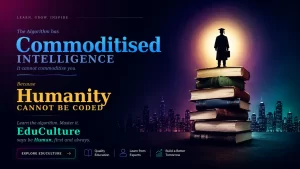
Today, algorithms have done something remarkable and unsettling at the same time. They have commoditised intelligence. A task that once required a sharp human mind, drafting, analysing, coding, diagnosing, optimising, can now be performed by a machine faster, cheaper, and with fewer errors. So, If what you have to offer is primarily cognitive output, you are now competing with something that never sleeps and processes thousands of data points while you are reading this sentence.

BUT, what the algorithm cannot do is be human. It cannot bring genuine compassion to a conversation. It cannot feel the weight of a decision that affects real lives. It cannot express joy in a way that is entirely its own. It has no Vivek, the Sanskrit word for discernment, the ability to know the right thing to do in a situation the training data never anticipated.

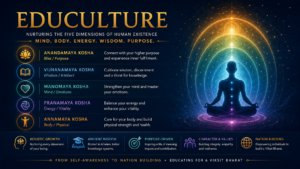
My book Freedom! Let Us Begin the Journey… draws on the Vedantic PanchaKosha framework, the five dimensions of human existence from the physical body to the deepest layer of bliss and being. That framework offers students something no algorithm can replicate: a map of the interior. A language for becoming fully human rather than merely highly functional.

hashtagEduCulture says this plainly. Learn the algorithm, absolutely. Master it, use it, deploy it. And then remember that the hashtagalgorithm is the floor, hashtagHumanity is the ceiling. Your hashtagkindness, your hashtagintegrity, your hashtagawareness of others, your capacity for hashtagjoy that is distinctly and irreducibly yours, these are what make you a person rather than a very expensive process.

The friends I kept from IIT Kharagpur are still with me. The ones whose intelligence I admired in 1997 are a memory. The ones whose character I trusted are still a phone call away.

Which one are you building, in yourself and in the students you are shaping?

EduCulture, IKS & NEP 2020: Why Universities Must Teach Self-Awareness

The most important course I did at Indian Institute of Management, Calcutta had nothing to do with Finance, Marketing, Systems or Strategy.

It was called ‘Management of Self in an Organisation”. Prof. Leena Chatterjee taught it for nearly 35 years in the Behavioural Sciences department. She was repeatedly voted Professor of the Year by students. Ask any IIM Calcutta alumnus about most important course and a disproportionate number will name that one. The course asked the one question every other course on campus carefully avoided: who are you, and how do you lead from that place? That course was IKS without being called IKS. It was EduCulture before I had a name for it.

Here is the uncomfortable reality about Indian universities in 2026. Over 8,000 higher education institutions have begun adopting IKS in curricula under NEP 2020. 30+ IKS centres have been established. The policy intent is genuine and the effort is real, yet India’s graduate employability rate is around 50% and more than half our university output struggles to find meaningful work. We are producing degrees faster than we are producing human beings equipped to use them.


The problem lies in the gap between policy and practice, between a curriculum that lists IKS as an elective and an institution that actually transmits civilisational wisdom as lived understanding. Universities in the name of appearing secular have thrown the baby out with the bathwater. They stripped out the inner formation that ancient Indian education placed at its centre.


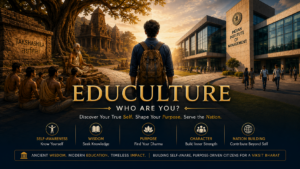
A student of Takshashila graduated knowing medicine, statecraft, philosophy, and their own mind. Our current university model graduates a student knowing their specialisation and very little else, certainly very little about themselves.


The new role of universities in nation building is producing citizens who know themselves deeply enough to serve something larger than their salary package. Prof LinChat understood this forty years ago and NEP 2020 has now written it into policy. The gap that remains is implementation.


This is where EduCulture enters as a framework for implementation, and where my book Freedom! Let Us Begin the Journey… offers something practical. The Vedantic PanchaKosha framework, five dimensions of human existence from the physical to the blissful, gives universities a structured map for whole-person education. It is ancient, rigorous, and maps cleanly onto everything modern psychology tells us about peak performance, self-awareness, and leadership. It requires zero compromise of academic standards and zero imposition of religious belief.


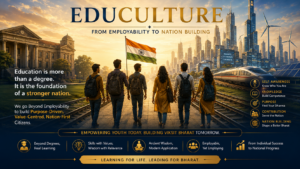
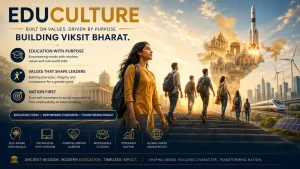
India is building Viksit Bharat on the foundation of its youth. That foundation requires both technical skill and civilisational grounding. The question every VC in India should be asking: what does my institution do, specifically, to ensure a student leaves knowing who they are?

Divine Intelligence and Human Innovation: Understanding Bhagavad Gita 10.41 in Modern Life

यद्यद्विभूतिमत्सत्त्वं श्रीमदूर्जितमेव वा |
तत्तदेवावगच्छ त्वं मम तेजोंऽशसम्भवम् || BG 10.41 ||

(जो-जो भी ऐश्वर्ययुक्त, लक्ष्मीयुक्त और कान्तियुक्त अथवा शक्तिमान वस्तु है, उस-उसको तुम मेरे तेज के अंश से ही उत्पन्न हुई जानो।)

(Whatever opulence, effulgence, and potent power you see, know that to be born of but a fraction of My splendor.)

Every extraordinary talent, beauty, or powerhouse creation in the universe originates from the same divine source.

Let’s take a look at how this divine brilliance manifests in our daily lives. Consider the life of a homemaker today compared to the early 1900s:

Then: Hours spent washing clothes by hand, grinding spices manually, and cooking over smoky wood stoves.
Now: Washing machines, mixer-grinders, and smart microwaves save hours of labor and protect health.

Every technological breakthrough, from the simple refrigerator to modern smart home automation, is an extension of human intelligence.
As Shri Krishn explains in this shlok, any extraordinary capability, beauty, or excellence in this world is not random. It is a tiny spark of Divine’s boundless energy and splendor channelled through human minds to make the world better.

When we appreciate technology, we are ultimately appreciating the source of that intelligence. Likewise, every spark of intelligence is divine expression hence best used for LokSangrah, welfare of all.

Ekadashi, Autophagy & EduCulture: Ancient Wisdom Meets Modern Science

Tomorrow it’s Parama Ekadashi, and I am fasting, no food, no water.

I have been observing every Ekadashi as Nirjala since last year, a birthday gift I gave myself as I got to mid-40s and felt my metabolism asking for a different kind of attention. Before that, for nearly a decade, Nirjala was only once a year. But I am getting ahead of myself. Let me start with a Nobel Prize.

In 2016, Japanese scientist Yoshinori Ohsumi won the Nobel Prize in Physiology or Medicine for discovering the science behind autophagy. The word comes from the Greek auto, self, phagein, to eat. Self-eating. When the body is deprived of food, it turns inward and begins consuming its own damaged cells, thereby breaking down toxic cellular buildup that accumulates with age, hence triggering a deep internal reset.

Research shows autophagy meaningfully activates after 16 to 24 hours of fasting and intensifies as the fast continues. Today, autophagy is the hottest concept in global wellness. Biohackers swear by it, longevity clinics charge handsomely for protocols built around it, and Silicon Valley has done what it is really good at i.e. turned it into a subscription.

If India had a Ministry of EduCulture, it would have surely built on if not led from front on Autophagy Research because it has encoded it into a lunar calendar for Free, twice a month, for everyone. A reset built into the rhythm of daily life thousands of years before Ohsumi’s laboratory existed. Based in Nobel Laureate’s research is our argument still going to be that Indian civilisation arrived at 24-hour fasting by accident? Isnt it entirely possible that it arrived there through centuries of careful observation of the human body from the inside out. This is precisely the hashtag#EduCulture argument I keep making: we have stopped teaching our children why our traditions work. We perform them. We have largely stopped understanding them. And in that gap between ritual and meaning, an entire generation grows up dismissing as superstition what a Nobel committee is now awarding prizes to explain.

Nirjala Ekadashi — the most demanding of all, the one without even water — falls on June 25, 2026. Fifteen days from today.

Here is my invitation.

Start tomorrow if you can on Parama Ekadashi, observe it with water only, a full day without food. That alone puts you past the 16-hour mark where autophagy begins. Let your body remember what it feels like to be clean from the inside. Then, between now and June 25, observe each meal with a little more intention. On June 25, if your doctor gives you the go-ahead, join me for Nirjala, no food, no water, sunrise to the morning of June 26. I will be doing it regardless. I do it every fortnight now.

This is what EduCulture means to me in practice. Not just writing about our civilisational inheritance. Living it. Understanding why it works. And inviting others to do the same. Mark June 25. Your cells will thank you in ways that took a Nobel Prize to articulate.