
Why Character Matters More Than Intelligence in the Age of AI

What struck me most when I started living at Indian Institute of Technology, Kharagpur campus was the sheer density of raw intelligence all around me. One kid was super brilliant in optics, other in probability, 3rd in thermodynamics and so one. Yet, the closest friends became the ones who were kind, compassionate, honest, responsible and aware.

Chanakya, who walked the soil of my home state Bihar more than 2,300 years ago and wrote the Arthashastra, perhaps the most strategically sophisticated political treatise ever produced on this subcontinent, also wrote that a leader without character is the most dangerous creature in any institution. His ideal was the Rajarishi, the philosopher-king, a person in whom intelligence and inner formation were inseparable. Chanakya trained Chandragupta Maurya the man before he built Chandragupta Maurya the emperor.

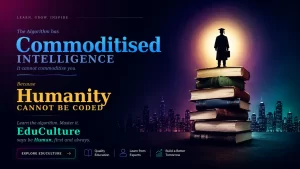
Today, algorithms have done something remarkable and unsettling at the same time. They have commoditised intelligence. A task that once required a sharp human mind, drafting, analysing, coding, diagnosing, optimising, can now be performed by a machine faster, cheaper, and with fewer errors. So, If what you have to offer is primarily cognitive output, you are now competing with something that never sleeps and processes thousands of data points while you are reading this sentence.

BUT, what the algorithm cannot do is be human. It cannot bring genuine compassion to a conversation. It cannot feel the weight of a decision that affects real lives. It cannot express joy in a way that is entirely its own. It has no Vivek, the Sanskrit word for discernment, the ability to know the right thing to do in a situation the training data never anticipated.

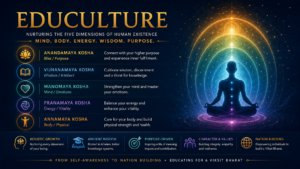
My book Freedom! Let Us Begin the Journey… draws on the Vedantic PanchaKosha framework, the five dimensions of human existence from the physical body to the deepest layer of bliss and being. That framework offers students something no algorithm can replicate: a map of the interior. A language for becoming fully human rather than merely highly functional.

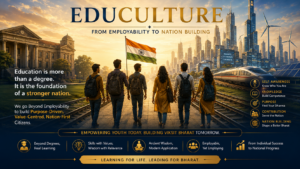
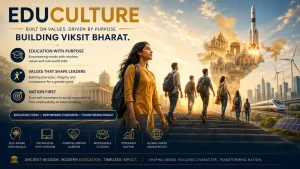
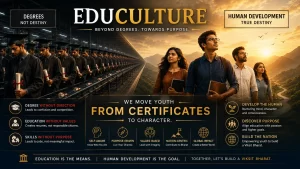
hashtagEduCulture says this plainly. Learn the algorithm, absolutely. Master it, use it, deploy it. And then remember that the hashtagalgorithm is the floor, hashtagHumanity is the ceiling. Your hashtagkindness, your hashtagintegrity, your hashtagawareness of others, your capacity for hashtagjoy that is distinctly and irreducibly yours, these are what make you a person rather than a very expensive process.

The friends I kept from IIT Kharagpur are still with me. The ones whose intelligence I admired in 1997 are a memory. The ones whose character I trusted are still a phone call away.

Which one are you building, in yourself and in the students you are shaping?
EduCulture, IKS & NEP 2020: Why Universities Must Teach Self-Awareness

The most important course I did at Indian Institute of Management, Calcutta had nothing to do with Finance, Marketing, Systems or Strategy.

It was called ‘Management of Self in an Organisation”. Prof. Leena Chatterjee taught it for nearly 35 years in the Behavioural Sciences department. She was repeatedly voted Professor of the Year by students. Ask any IIM Calcutta alumnus about most important course and a disproportionate number will name that one. The course asked the one question every other course on campus carefully avoided: who are you, and how do you lead from that place? That course was IKS without being called IKS. It was EduCulture before I had a name for it.

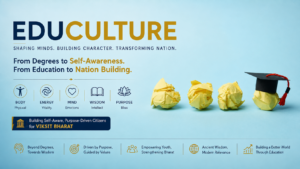
Here is the uncomfortable reality about Indian universities in 2026. Over 8,000 higher education institutions have begun adopting IKS in curricula under NEP 2020. 30+ IKS centres have been established. The policy intent is genuine and the effort is real, yet India’s graduate employability rate is around 50% and more than half our university output struggles to find meaningful work. We are producing degrees faster than we are producing human beings equipped to use them.


The problem lies in the gap between policy and practice, between a curriculum that lists IKS as an elective and an institution that actually transmits civilisational wisdom as lived understanding. Universities in the name of appearing secular have thrown the baby out with the bathwater. They stripped out the inner formation that ancient Indian education placed at its centre.


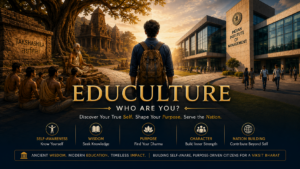
A student of Takshashila graduated knowing medicine, statecraft, philosophy, and their own mind. Our current university model graduates a student knowing their specialisation and very little else, certainly very little about themselves.


The new role of universities in nation building is producing citizens who know themselves deeply enough to serve something larger than their salary package. Prof LinChat understood this forty years ago and NEP 2020 has now written it into policy. The gap that remains is implementation.


This is where EduCulture enters as a framework for implementation, and where my book Freedom! Let Us Begin the Journey… offers something practical. The Vedantic PanchaKosha framework, five dimensions of human existence from the physical to the blissful, gives universities a structured map for whole-person education. It is ancient, rigorous, and maps cleanly onto everything modern psychology tells us about peak performance, self-awareness, and leadership. It requires zero compromise of academic standards and zero imposition of religious belief.


India is building Viksit Bharat on the foundation of its youth. That foundation requires both technical skill and civilisational grounding. The question every VC in India should be asking: what does my institution do, specifically, to ensure a student leaves knowing who they are?