

The most important course I did at Indian Institute of Management, Calcutta had nothing to do with Finance, Marketing, Systems or Strategy.
It was called ‘Management of Self in an Organisation”. Prof. Leena Chatterjee taught it for nearly 35 years in the Behavioural Sciences department. She was repeatedly voted Professor of the Year by students. Ask any IIM Calcutta alumnus about most important course and a disproportionate number will name that one. The course asked the one question every other course on campus carefully avoided: who are you, and how do you lead from that place? That course was IKS without being called IKS. It was EduCulture before I had a name for it.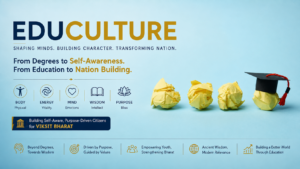
Here is the uncomfortable reality about Indian universities in 2026. Over 8,000 higher education institutions have begun adopting IKS in curricula under NEP 2020. 30+ IKS centres have been established. The policy intent is genuine and the effort is real, yet India’s graduate employability rate is around 50% and more than half our university output struggles to find meaningful work. We are producing degrees faster than we are producing human beings equipped to use them.
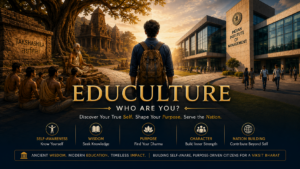
The problem lies in the gap between policy and practice, between a curriculum that lists IKS as an elective and an institution that actually transmits civilisational wisdom as lived understanding. Universities in the name of appearing secular have thrown the baby out with the bathwater. They stripped out the inner formation that ancient Indian education placed at its centre.
A student of Takshashila graduated knowing medicine, statecraft, philosophy, and their own mind. Our current university model graduates a student knowing their specialisation and very little else, certainly very little about themselves.
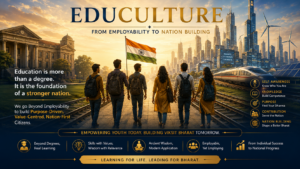
The new role of universities in nation building is producing citizens who know themselves deeply enough to serve something larger than their salary package. Prof LinChat understood this forty years ago and NEP 2020 has now written it into policy. The gap that remains is implementation.

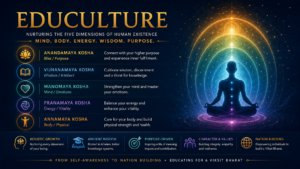
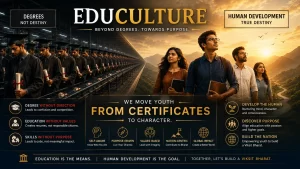
This is where EduCulture enters as a framework for implementation, and where my book Freedom! Let Us Begin the Journey… offers something practical. The Vedantic PanchaKosha framework, five dimensions of human existence from the physical to the blissful, gives universities a structured map for whole-person education. It is ancient, rigorous, and maps cleanly onto everything modern psychology tells us about peak performance, self-awareness, and leadership. It requires zero compromise of academic standards and zero imposition of religious belief.
India is building Viksit Bharat on the foundation of its youth. That foundation requires both technical skill and civilisational grounding. The question every VC in India should be asking: what does my institution do, specifically, to ensure a student leaves knowing who they are?