Why India Needs a Ministry of EduCulture

Why India Needs a Ministry of EduCulture

India has a Ministry of Education with budget this year of ₹1,39,286 crore, and a Ministry of Culture with ₹3,361 crore budget.

Between these two ministries, there is no conversation. One produces degrees and the other preserves monuments. Neither is asking the question that matters most in the AI era: What kind of human being are we producing, and does that human being know who they are?

This is why India needs a Ministry of EduCulture. A full ministry with a mandate, a budget, and a brief that treats culture as education to be lived, not merely heritage to be archived.

Look at what South Korea did. In 2008, after an economic crisis left the country on its knees, it created a Ministry of Culture, Sports and Tourism with one clear understanding: cultural identity is a strategic industry. For 2026, that ministry’s budget stands at 7.86 trillion won, an 11.2% increase, placing culture, sports and tourism among the most aggressively funded policy areas in the country. The S.Korean government has set a target to grow the K-culture industry to 300 trillion won by 2030. South Korea got BTS because a government decided, twenty-five years ago, that culture was worth serious investment.

India is sitting on a civilisational inheritance infinitely older and richer than K-pop. Its culture budget is a rounding error against its education budget and the result is visible everywhere. There is no need to dry the ink talking about what level of Education is being received by this huge taxpayer spent. But, the biggest worry is that we are producing educated people who have no felt relationship with the story tradition that shaped the civilisation they grew up in. Professionals fluent in frameworks imported from Stanford and McKinsey, unable to articulate why the conversation between Shri Krishn and Arjun remains the most sophisticated piece of leadership literature ever written. The question of who we are as a people, and what our stories are actually for, goes unasked in every classroom.

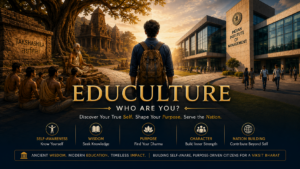
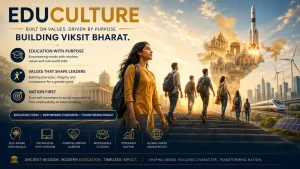
Solution? Imagine how nicely a Ministry of EduCulture would build the Ramlila as an event management and economic ecosystem, the way Bali built the Kecak. So, the vision of this ministry will be to integrate civilisational fluency into education, so a child finishing school in 2030 knows both how to use AI and what they are here for. These are questions I have been pondering over for a long time, long enough that a part of it even became a book, “Freedom! Let Us Begin the Journey…” an exploration of the inward path that runs beneath all outward skill.

Coming back to Government action, it is true that the NEP spoke of Indian knowledge systems, buts its been actioned merely like a policy paragraph, which is a good beginning at best. A ministry with a mandate and money is a different matter altogether. Tag someone in government who should read this. Or DM me if you are already working for hashtag#EduCulture

EduCultured Youth will Lead the way in AI Era

EduCultured Youth will Lead the way in AI Era

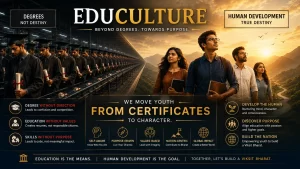
Look at the young person sitting across from you in the next team meeting. Chances are they know how to use five AI tools, can automate a workflow in an afternoon, and have a ChatGPT tab permanently open. And yet, when the actual problem needs a decision, a direction, a point of view rooted in something deeper than a prompt, perhaps they have gone quiet.

This issue is being noticed by many but not talked about openly as yet, and I blame the breakneck pace of changes to deal with by one and all. I dont think we should blame AI here as AI is simply the “loudest” mirror we have ever held up to ourselves. What it reflects, for a whole generation of educated but not cultured youth, is a gap between information and wisdom, between skillset and character, between knowing what to do and understanding why it matters.

The Sanskrit word Vivek means discernment, the ability to separate what is real from what is maya, what is right from what is merely convenient. It is neither taught in engineering colleges, nor is available as a course on Coursera as yet. The ability to differentiate between sat-asat, dharm-adharm slowly grows in a person who has been dealing with real life situations of ambiguity, and looked for references within and in collective experiences of the society presented as Culture.

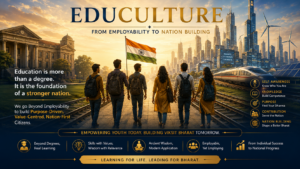
An EduCultured youth is one who carries both. Educated enough to operate in the AI era, and Cultured enough to lead in it.

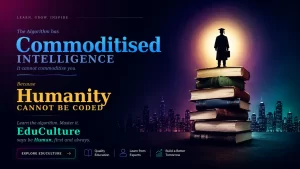
Because AI will very efficiently give you ten answers to any question you ask. The one thing it cannot do is decide which question deserves to be asked in the first place. That judgment comes from somewhere the algorithm cannot reach as yet. It comes from a civilisation’s accumulated sense of what a human life is actually for.

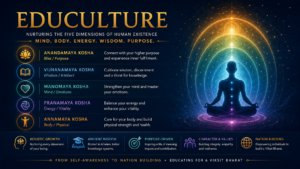
This question of Vivek, of how to listen to what is real beneath all the noise, is precisely what I have been focusing on in my own life for a long time. Eventually it became a book, “Freedom! Let Us Begin the Journey” which is an exploration of that inward path, drawing from the Vedantic framework of the PanchaKoshas, the five sheaths through which we either live consciously or simply drift. If the idea of knowing yourself as clearly as you know your productivity tools interests you, the link is in the comments.

India has spent thousands of years asking the harder questions. The epic Mahabharat did not just teach archery to Arjuna, and through him everyone who came after, that the battle outside is always a shadow of the one within and Bhagvad Gita guides us through this journey. The youth who will lead in the AI era will be technically capable, yes. But also rooted. Grounded in something larger than their last performance review or their Social Media Posts’ likes and followers count.

The question worth pondering is this: are we raising young people who know only how to use AI, or young people who also know why they are here?