Raising Rooted Children in the Age of AI: Why Vedantic Self-Knowledge Matters More Than Ever

Every week, I sit with my two teenage sons and we go through the hashtagBhagavadGita together, more than religious instruction for philosophical training. I want them equipped with the deepest Vedantic concepts our civilisation has produced before they fly off the nest for higher studies, because I suspect the world they are flying into will ask them “who are you” with a force and frequency I never faced at their age.

I do not know how hashtagAI is going to change everything. What I do know is what I am trying to do with whatever time and capability I have. Build my sons’ arsenal of self-knowledge deep enough that nothing can hollow out their sense of who they are. And in parallel, become more deliberately involved in questions of culture and identity myself, so that this extraordinarily powerful technology gets pointed, even in some small way, toward making the world better for them.

Here is the elephant in the room, named directly. We are at real risk of AI quietly homogenising human culture. A model trained mostly on English-language internet data does not just answer in English. It begins to think in the assumptions, the references, the aesthetic instincts of whoever produced the most text online. Without deliberate correction, “global AI” risks becoming, by sheer statistical gravity, a culturally narrow AI wearing a universal costume. A child anywhere on earth could grow up asking an AI about identity and receive an answer rootless to their own soil.

There is a second risk, say if a teenager can ask an AI about the hashtagGita instead of sitting weekly with a parent who has wrestled with it personally, something in the chain of transmission breaks, even if the algorithm’s answer is technically correct.

And underneath both risks lies the deepest one, that if AI becomes capable enough at everything, will an entire generation simply stop asking who they are at all, because the question stops feeling necessary?

I do not think the answer is rejecting the technology because the tool itself is not the problem. The question is what steers it. There are already real examples of AI pointed in the right direction. The Cherokee Nation partnered with Microsoft to build an AI-powered Cherokee keyboard and text-to-speech tools, now used in tribal schools where fewer than 2,000 fluent speakers remain. Manx, a Celtic language UNESCO had declared extinct, is being taught to children again and now available inside major translation platforms. Meta’s No Language Left Behind project built translation models for over 50 African languages. In each of these cases, the technology became a life raft for the culture to keep speaking in its own voice, to its own children, on its own terms.

My sons will leave home soon enough. I cannot control what AI becomes in the years they are away from home. What I can control is whether they leave carrying a hashtagVedantic arsenal substantial enough to ask better questions than the ones any model hands them by default.

Why Character Matters More Than Intelligence in the Age of AI

What struck me most when I started living at Indian Institute of Technology, Kharagpur campus was the sheer density of raw intelligence all around me. One kid was super brilliant in optics, other in probability, 3rd in thermodynamics and so one. Yet, the closest friends became the ones who were kind, compassionate, honest, responsible and aware.

Chanakya, who walked the soil of my home state Bihar more than 2,300 years ago and wrote the Arthashastra, perhaps the most strategically sophisticated political treatise ever produced on this subcontinent, also wrote that a leader without character is the most dangerous creature in any institution. His ideal was the Rajarishi, the philosopher-king, a person in whom intelligence and inner formation were inseparable. Chanakya trained Chandragupta Maurya the man before he built Chandragupta Maurya the emperor.

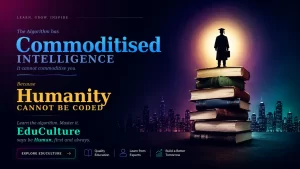
Today, algorithms have done something remarkable and unsettling at the same time. They have commoditised intelligence. A task that once required a sharp human mind, drafting, analysing, coding, diagnosing, optimising, can now be performed by a machine faster, cheaper, and with fewer errors. So, If what you have to offer is primarily cognitive output, you are now competing with something that never sleeps and processes thousands of data points while you are reading this sentence.

BUT, what the algorithm cannot do is be human. It cannot bring genuine compassion to a conversation. It cannot feel the weight of a decision that affects real lives. It cannot express joy in a way that is entirely its own. It has no Vivek, the Sanskrit word for discernment, the ability to know the right thing to do in a situation the training data never anticipated.

My book Freedom! Let Us Begin the Journey… draws on the Vedantic PanchaKosha framework, the five dimensions of human existence from the physical body to the deepest layer of bliss and being. That framework offers students something no algorithm can replicate: a map of the interior. A language for becoming fully human rather than merely highly functional.

hashtagEduCulture says this plainly. Learn the algorithm, absolutely. Master it, use it, deploy it. And then remember that the hashtagalgorithm is the floor, hashtagHumanity is the ceiling. Your hashtagkindness, your hashtagintegrity, your hashtagawareness of others, your capacity for hashtagjoy that is distinctly and irreducibly yours, these are what make you a person rather than a very expensive process.

The friends I kept from IIT Kharagpur are still with me. The ones whose intelligence I admired in 1997 are a memory. The ones whose character I trusted are still a phone call away.

Which one are you building, in yourself and in the students you are shaping?

Beyond Skills: Giving Teenagers a Compass for the Future

Think about the hashtag#teenager in your home or near you. Smart, capable, digitally fluent, and at the same time also overwhelmed in ways they cannot name. We live in a hashtag#VUCA world (Volatile, Uncertain, Complex, and Ambiguous). hashtag#AI has turbocharged these as it rewrites entire industries between one school year and the next. A young person today will navigate careers, relationships, and ethical choices that no previous generation has a map for. And into this storm, we are sending them armed with information and skills, but almost no internal compass.

Every civilisation that lasted long enough to be worth studying understood that hashtag#puberty is the precise moment to hand a young person that compass. The Jewish Bar Mitzvah assigns a 13-year-old with an important responsibility. From this day, you are answerable for your own actions. Similarly, the Aboriginal Walkabout sends a boy into the wilderness alone for months, to deepen his connection to identity and belonging before he returns as a man. Japan’s Seijin Shiki gathers every young person who has turned 20 and says collectively: you belong to this society now. You owe it something.

Indian Culture had its own answer, the hashtag#Janeu or hashtag#Upanayan sanskar just before hitting puberty. Upanayan means bringing near, bringing a young person into proximity with dharm, with their own deeper nature. The child receives the sacred thread, taught the Gayatri mantr, and is formally initiated into student life under a guru. In South India, the Ritu Kala Samskaram marks the same threshold for girls. These are civilisational frameworks designed at exactly the moment a young person most needs one. There is nothing stopping us from removing any caste, religion and gender barrier from this sanskar, is there? Who will say no for this to their child? Gargi underwent it. Maitreyi underwent it.

At the heart of the Upanayana is hashtag#Vivek, the faculty of discernment, the ability to distinguish hashtag#dharm from adharm, right action from merely convenient action. A young person with Vivek does not get overwhelmed by VUCA. They read it, they develop appropriate frameworks and become capable of seeing around corners, prepare for what may be coming, and make their moves with steadiness and purpose. That is a very different thing from anxiety, from reactivity, from the paralysis that so many young people carry today without even knowing why.

Most Indian families still perform the Upanayan, but the gap between ritual and meaning is the gap an entire generation is falling through.

hashtag#EduCulture proposes to close it. A young person shaped by their civilisational inheritance does not need to be told how to behave in a VUCA world. They already carry the framework. They know what changes and what stays constant. They can take advantage of what is coming without losing their sense of what is right.

When did we decide that producing skilled people was enough, and stopped asking whether we were producing good ones?

EduCultured Youth will Lead the way in AI Era

EduCultured Youth will Lead the way in AI Era

Look at the young person sitting across from you in the next team meeting. Chances are they know how to use five AI tools, can automate a workflow in an afternoon, and have a ChatGPT tab permanently open. And yet, when the actual problem needs a decision, a direction, a point of view rooted in something deeper than a prompt, perhaps they have gone quiet.

This issue is being noticed by many but not talked about openly as yet, and I blame the breakneck pace of changes to deal with by one and all. I dont think we should blame AI here as AI is simply the “loudest” mirror we have ever held up to ourselves. What it reflects, for a whole generation of educated but not cultured youth, is a gap between information and wisdom, between skillset and character, between knowing what to do and understanding why it matters.

The Sanskrit word Vivek means discernment, the ability to separate what is real from what is maya, what is right from what is merely convenient. It is neither taught in engineering colleges, nor is available as a course on Coursera as yet. The ability to differentiate between sat-asat, dharm-adharm slowly grows in a person who has been dealing with real life situations of ambiguity, and looked for references within and in collective experiences of the society presented as Culture.

An EduCultured youth is one who carries both. Educated enough to operate in the AI era, and Cultured enough to lead in it.

Because AI will very efficiently give you ten answers to any question you ask. The one thing it cannot do is decide which question deserves to be asked in the first place. That judgment comes from somewhere the algorithm cannot reach as yet. It comes from a civilisation’s accumulated sense of what a human life is actually for.

This question of Vivek, of how to listen to what is real beneath all the noise, is precisely what I have been focusing on in my own life for a long time. Eventually it became a book, “Freedom! Let Us Begin the Journey” which is an exploration of that inward path, drawing from the Vedantic framework of the PanchaKoshas, the five sheaths through which we either live consciously or simply drift. If the idea of knowing yourself as clearly as you know your productivity tools interests you, the link is in the comments.

India has spent thousands of years asking the harder questions. The epic Mahabharat did not just teach archery to Arjuna, and through him everyone who came after, that the battle outside is always a shadow of the one within and Bhagvad Gita guides us through this journey. The youth who will lead in the AI era will be technically capable, yes. But also rooted. Grounded in something larger than their last performance review or their Social Media Posts’ likes and followers count.

The question worth pondering is this: are we raising young people who know only how to use AI, or young people who also know why they are here?