

मन की बात
20 Summit इंडोनेशिया दौरे पर PM मोदी जानें, क्यों है ये सम्मेलन खास ?
Droupadi Murmu Creates History
With Droupadi Murmu going to occupy the highest office of the country, India has made yet another great stride towards empowerment of the apparently most downtrodden section of society that she belongs to. Her irresistible rise is also an inspiration for all those constituting in crores, aspiring to do something big in life, and are somewhere in the process of nation building.
Ever since the Narendra Modi-led government came into power at the Centre, several pre-conceived and established social, political and cultural notions have been shaken with an indefatigably driven zeal to build the nation and society. By altering the established framework of governance and bringing far-reaching changes like never before, this development has also debunked the latent and hierarchical narratives of the Indian society.
Droupadi Murmu’s elevation to the top job has reaffirmed the idea of honouring the neglected sections of society by strengthening the bond between different communities for national unity and social harmony. What may have been unthinkable for the majority of the family-led parties ruling the political firmament for decades, has come to reality. Murmu is not just a lady belonging to the tribal community, rather she represents a strong community that fought even against the oppressive British government for their motherland.
Now putting the community on an equal footing with mainstream Indian society, the development has much more powerful political, social and cultural connotations, which promise to demolish a discriminatory tribal versus non-tribal binary constructed long before first by British colonial rulers and later bolstered by successive political establishments in several parts of the country.
In the last 8 years, a number of efforts and initiatives have been taken to bridge the physical gaps between different regions and communities, especially with the north-eastern and other such neglected zones of the country. This presidential election is an emotional move to bring around 8.2% of the population and about 10.42 crore in number as per the 2011 Census, closer to the heart of the country. At the same time, this outreach to tribal is also inspired by the notion of acknowledging diversity with their individuality being equally respected with long-term cultural and social dividends well beyond the more immediate political and electoral gains.
PM ने दी बड़ी खुशखबरी 18 महीने में 10 लाख नौकरियां
पीएम केयर फॉर चिल्ड्रन केंद्र सरकार ने जारी किया दिशा निर्देश
7 साल देश की रक्षा बेमिसाल

To Do or Not to Do?

Why do we not do what we should be doing and do what we should not.
This burning question churns our mind and shows us a mirror to our actions in which we are feverishly involved day in and day out. Often our myopic vision limits us to me and mine, and rarely we see our position from the broader perspective of society, country or the world. We all get such opportunities however small or irrelevant it might feel at that time.
A village teacher who can educate APJ Kalam, a bank manager who went out of his way to loan a student and make a noble doctor out of him, a mother who can give her boy upbringing to become Bhagat Singh. All such opportunities are directly given to us to be the instrument of change. It might be a drop, but that’s what makes an ocean bit by bit.
Our Sikh gurus have fought the holy war for generations, the atrocities caused to them gives us goosebumps and brings tears to our eyes when we listen to the personal sacrifices they incurred to hold on to the flag of Dharma. This spirit of individual Dharma builds our society step by step, if we shrug it off and pass it to someone else, and he/she does the same, the undercurrent of non performance starts eroding our society and eats it up. With the passage of time, the results are seen as the downfall and break down of the system.
Krishna explains two types of sins to Arjuna in the middle of the battlefield. We all are doing Sin of Commission ( (we are doing something that we should not do.) out of attachment, love and sometimes fear and turn our heads away from our responsibilities towards a greater cause (Sin of omission).
It’s a sin to close our eyes towards a situation and shrug it off our shoulders and pass the baton to the government or other authorities when our mere interference could have solved the problem. We can give an umpteen number of reasons for not doing what we should be doing and paint ourselves as examples for our children and future generations. They will follow our footsteps , we are the shining heroes for them. By not participating proactively by thought, word and action, we are incurring a sin.
Martin Luther King Jr. famous quote says, “We will have to repent in this generation not merely for the hateful words and actions of the bad people but for the appalling silence of the good people.”
We are the creators of the world we live in. We have to participate to build it, we have to fight it out, if not, then one day the rising waters of doom will reach our door steps too, and we will be washed away into oblivion by the ruthless mother nature. No blame, No arguments, No possession will save us then.
So the decision is ours. Do we sit on the boundaries and watch the tides rise or do we jump in to create some bridges?
What is my Dharma?

कुरुक्षेत्र के बीचोबीच अर्जुन असमंजस की स्थिति में हैं, और विषाद में हैं, भगवान उनकी मदद कर रहे हैं कि आप सही बात को समझो। अपने असली स्वरूप को, आत्मस्वरूप को, समझना अत्यंत आवश्यक है और सबसे हितकारी भी। यद्यपि शायद अर्जुन अभी वह गूढ़ विषय समझ पाने की स्थिति में नहीं हैं, अतः श्रीकृष्ण स्वधर्म की बात करते हैं, यानी कि आखिर हमारा धर्म क्या है?
सामान्यतः, इसको हम 2 वर्गों में बाँट सकते हैं। एक जो है सामान्य धर्म है हमारा, कि कौन-कौन सी चीजें हैं जो हमें करनी चाहिए, जिसको हमारे शास्त्र ‘नियम’ कहते हैं। नियम क्या हैं हमारे? जैसे शौच(cleanliness), आहार(right food), स्वाध्याय(self-study) – कि खुद को अंदर-बाहर साफ रखना चाहिए, पौष्टिक खाना खाना चाहिए, सात्विक खाना खाना चाहिए, मन से स्वाध्याय करनी चाहिए, सत्व को पता करने की कोशिश करनी चाहिए। ये सारी चीज़ें जो हैं, वो नियम के अंदर आती हैं और सभी को करनी चाहिए।
फिर बहुत सारी चीजें हैं जो कि नहीं करनी चाहिए। इनको ‘यम’ बोलते हैं — चोरी नहीं करनी चाहिए, झूठ नहीं बोलना चाहिए – ये सारी चीजें यम हैं और ये सबके लिए समान रूप से लागू हैं।
फिर आता है ‘विशेष धर्म’ – देश, काल, पात्र के अनुसार। यह हमारे role, place and time के हिसाब से निश्चित होता है। TRP – किस समय किस रोल में किस जगह पर हैं, उस हिसाब से यह decide होता है। इसमें हमारे पात्र अर्थात् role की अनिश्चितता ढेरों समस्याएँ पैदा कर देती है।
अगर हम सोचें कि अर्जुन के साथ क्या हुआ कुरुक्षेत्र के मध्य में? अर्जुन यहाँ पर अपने आपको एक धर्म के पक्ष में खड़े योद्धा के बजाय, अपने पितामह के प्रपौत्र, अपने मामा का भांजा, अपने गुरु का शिष्य – इन सारे पात्रों में देख रहे हैं स्वयं को।अर्जुन का ये जो confusion है, वो इस धर्मयुद्ध की जो स्थिति है, उसके विरुद्ध है क्योंकि वो अपने धर्म को नहीं समझ पा रहे हैं।
अतः हमारे व्यावहारिक जीवन में अपने सही पात्र यानी role की समझ अतिआवश्यक है। इस समझ से हमारा धर्म हमें सही सही और जल्द समझ में आ सकता है। ये जितना उलझा हुआ हमने बना रखा है उतना है नहीं है। क्योंकि हमारे अंदर वो समझ अंतर्निहित है जो आराम से बता सकता है कि हमने अपने role place को time को सही समझा है कि नहीं।
अगर विचार करने से, तर्क करने से, उदाहरण देने से, त्याग करने से, यज्ञ दान तप करने से, जंगलों मे रहने, भटकने से, यह सब कुछ करने से यह युद्ध, अर्थात् धर्म की हानि नहीं हो रही होती तो शायद इस युद्ध की आवश्यकता ही नहीं होती। वो सारे प्रयास हो चुके हैं, और अब ऐसे में एक क्षत्रिय क्या करे? उन सारे प्रयासों के बावजूद समाज की स्थिति यह है कि एक महारानी का चीरहरण हो रहा है, वह भी भरे राजदरबार में। उस समाज में फिर एक आम स्त्री की क्या हालत होगी! जहां पर, महाराज पाण्डु के पुत्रों को कम से कम आधा राज्य मिलना चाहिए, उनको 5 गांव तक नहीं मिल रहे। इतनी खुलेआम गुंडागर्दी! तो वहाँ के एक आम आदमी के property rights का क्या हाल हो रहा होगा? तो जब समाज मे इतनी अराजकता है तो ऐसे में एक क्षत्रिय का क्या धर्म है?
तभी भगवान श्रीकृष्ण बोल रहे हैं कि एक क्षत्रिय के लिए धर्म के लिए युद्ध करने से अच्छा क्या हो सकता है अब? सारे प्रयास, पूजा, तपस्या जब विफल हो चुके हैं तो अर्जुन अब यह जिम्मेदारी तुम्हारे कंधे पर है।और क्या तुम इसके लिए ही इतने वर्षों से तैयारी नहीं कर रहे हो? तो इसलिए भगवान बोलते हैं कि ये धर्म युद्ध है और इस चीज को समझो, ये तुम्हारा धर्म है, इस धर्म युद्ध में उठो और युद्ध करो।
आज के परिवेश में, आपके आस पास के सत्य, अहिंसा, करुणा आदि सदगुणों से वंचीत बन रहे व्यक्तित्वों के विरुद्ध युद्ध स्तर पर कार्य होना चाहिए कि नहीं? और आपके अलावा कौन है इसका अर्जुन?
Raag – Moha -Vishaad
Almost 5 million people have assembled to kill each other and most of them are indeed dead within 18 days, such is the state of affairs just before the beginning of Kaliyuga, in the battle of Kurukshetra, some 5000 years ago. Almost all assembled men knew that they were going to die soon or at best had 50:50 chances if they were ranked the top most and have trained almost their entire life as warriors. Staring straight at death, these men were sure that they were fighting in a war of Dharma. 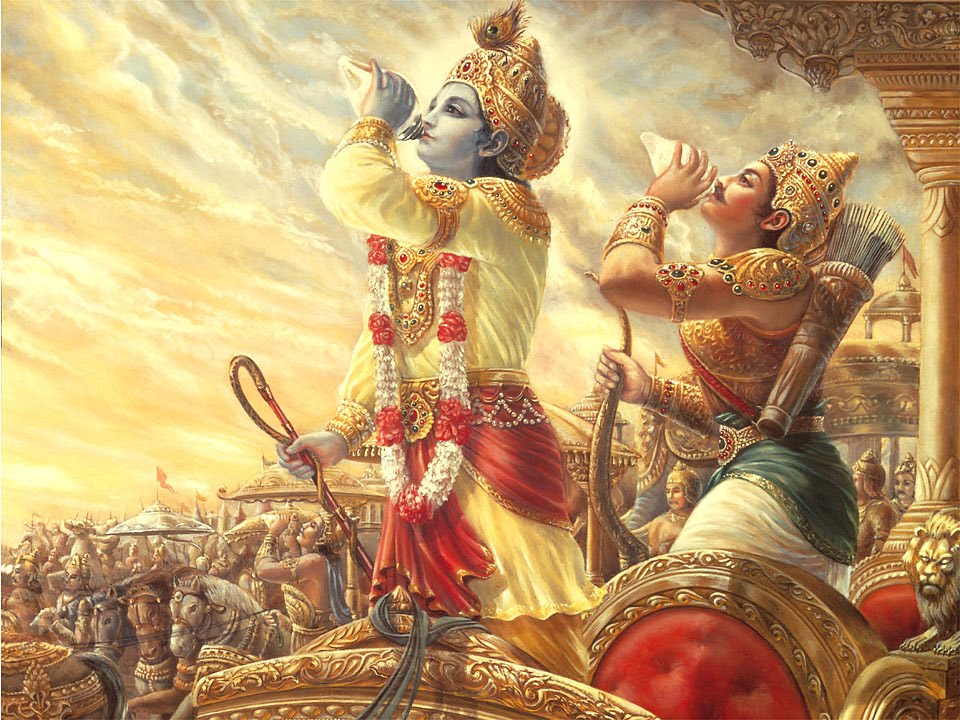
Dharma, a key concept for leading a meaningful and aware life, is rather simple to know yet difficult to explain in words. Every aware person knows what needs to be done to be fair and just given the time, role and place. One can jokingly say maintain your right course of action as per your TRP (time, role and place), not the BARC way. It requires a mature intellect to execute Dharmic life though.
A person of immature intellect though flirts with situations to put him in a position of despondency almost at every stage of his life. It’s a three step process, Raaga or attachment, Moha or delusion, and Shoka or Sorrow. Will look into details in this topic, but for now an example just before the beginning of the great war of Mahabharata is apt to understand.
Shri Krishna, Draupadi and Duryodhana – just these three knew very clearly that war is inevitable given how things had evolved, esp. over the previous 15-16 years, what was at stake now and what efforts had gone futile to prevent the war. If these three had changed their minds, one could argue that war would have been averted.
The key person for the war, Arjuna, has been preparing for this moment throughout his life, in a very focussed manner over the last 13 years for sure. He is the superstar whose skills and abilities would determine how long this war is going to last. Everyone knew it, he knew it and wanted to inspect Durbudhe, the evil minded ones, who came to fight him up close.
Cousin and friend, now acting as charioteer, Shri Krishna is asked by Arjuna to take him to the middle of the battleground so that he can look in the eyes of the enemy who have come here to be killed by him. It seems as if on purpose Shri Krishna stations him right in front of Arjuna’s beloved great grandfather Bhisma. Arjuna, who was clear in his mind that his opposition has assembled only to be wiped out by his arrows identifies his enemies as relatives now, Raaga (attachment) begins to unfold.
Arjuna, who knew very clearly that all options of averting the war have been exhausted and people have chosen their sides for the battle thereby he is looking at the enemy camp, yet keeps on dwelling on the thought that these are my relatives after all. This causes Moha, delusion, and he starts arguing with Krishna why they are in the wrong place and should abandon the post. Tendulkar doesn’t want to bat in the world cup final or Federer doesn’t feel like serving in the Wimbledon final!
Unchecked attachment leads to delusion which has just one destination and that is where Arjuna lands up. He is visibly distraught, feeling feverish, sweaty palms, shaky legs, dried mouth as if strong bouts of GERD are hitting him. Such is the state of the super-star who has lost clarity of his Dharma due to Raaga and Moha, and has become Despondent Arjuna – Arjuna in Vishaad.