

Raag or Prem (राग या प्रेम)

Big stage is set. Vijaya or Brihannala, the eunuch is charioteer to the young prince of Virata’s kingdom of Matsya, who has single handedly challenged the grand army with all important warriors of Hastinapur. Taking a decision without planning and not thinking of consequences is one of the key signals of a tamasic lifestyle, which will be looked into later on. Virata parv narrates the story of Arjuna in disguise rather than the young prince Uttar who wins the battle using sammohana Astra causing all in the opposition to fall asleep or swoon. Arjuna chooses not to kill any of them. Single handedly Arjuna had defeated all great warriors of opposition who were attacking him simultaneously. This same Arjuna has become despondent looking at the same enemy camp in Kurukshetra. Such is the power of Raaga leading to Moha, to Shoka!
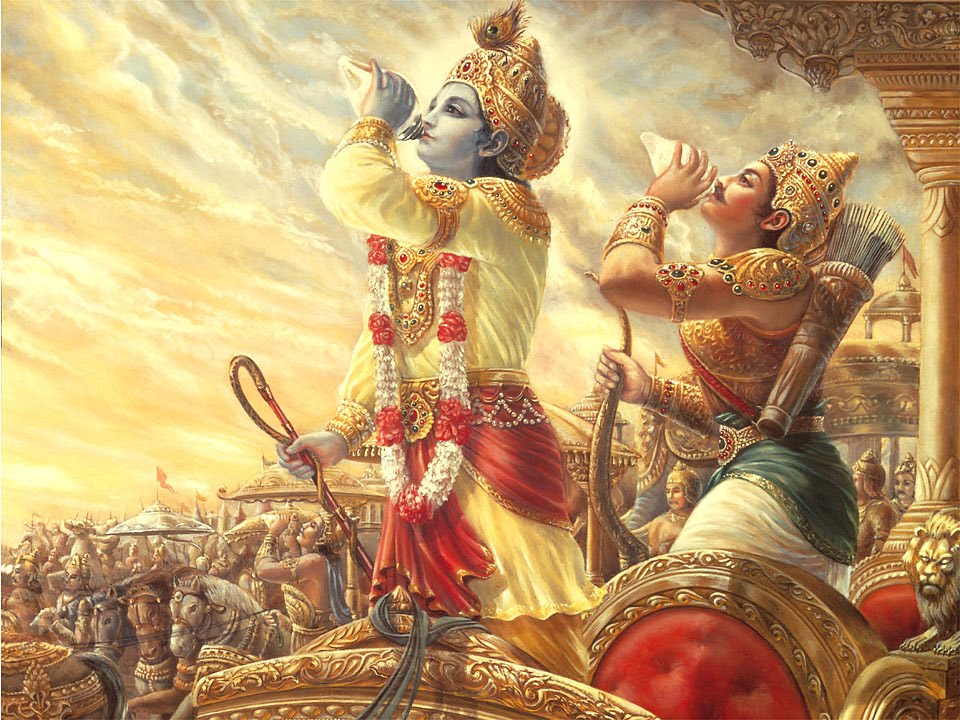
Not that he wasn’t clearheaded of modus operandi to win this war, he knew exactly what needs to be done and wanted to have just one last look before the war begins and the course of the history is moulded by his hands, well by his bow, Gaandiva. Such is the power of unchecked attachment, Raaga for the super-star of his times. What to say of mere mortals like us who are entangled in worldly affairs of earning the next promotion and settling the score with old friends and relatives turned enemies.

Ajuna’s despondency in the middle of the battleground is not due to his lack of ability. It is about lacking the clarity of his duty according to time, role and place. It is not realizing what his Dharma is. How many of us fall victim to our own lack of understanding of Dharma paving way of misery in our lives is beyond count. 

Natural question coming to our mind is, “Whole world says Love is the key to happiness and isn’t attachment just another name of Love”? Raaga or Emotional Attachment is fundamentally different to Prema or Love due to the nature of attraction. 

Raaga is due to selfish reasons while Prema is selfless.

One is trapped in the world of pleasure and pain due to dependence on emotional crutches. Emotional attachment to people, objects and situations (Vyakti Vastu Paristhiti) is the cause of all our pleasure and pain in the world. When we get addicted to these pleasures for want of more and pain to avoid at any cost, this psychological addiction leads to Moha.

Moha is the second stage of excesses of materialistic living. Mohini Shakti, power of delusion, is heavily described in our scriptures from various angles. It has huge potency to get us to start liking what is dangerous for us and hate what is really good for us. A free person would not like to engage in an act but willingly goes for it under the influence of Moha, such is its power. Arjuna was experiencing this as he kept on looking at his enemies yet identifying with them as relatives. He starts counting some 20+, seemingly good reasons why he should not kill them. Aren’t we all deluded like Arjuna due to unchecked attachments and material desires?
Raag – Moha -Vishaad

Almost 5 million people have assembled to kill each other and most of them are indeed dead within 18 days, such is the state of affairs just before the beginning of Kaliyuga, in the battle of Kurukshetra, some 5000 years ago. Almost all assembled men knew that they were going to die soon or at best had 50:50 chances if they were ranked the top most and have trained almost their entire life as warriors. Staring straight at death, these men were sure that they were fighting in a war of Dharma.

Dharma, a key concept for leading a meaningful and aware life, is rather simple to know yet difficult to explain in words. Every aware person knows what needs to be done to be fair and just given the time, role and place. One can jokingly say maintain your right course of action as per your TRP (time, role and place), not the BARC way. It requires a mature intellect to execute Dharmic life though.

A person of immature intellect though flirts with situations to put him in a position of despondency almost at every stage of his life. It’s a three step process, Raaga or attachment, Moha or delusion, and Shoka or Sorrow. Will look into details in this topic, but for now an example just before the beginning of the great war of Mahabharata is apt to understand.

Shri Krishna, Draupadi and Duryodhana – just these three knew very clearly that war is inevitable given how things had evolved, esp. over the previous 15-16 years, what was at stake now and what efforts had gone futile to prevent the war. If these three had changed their minds, one could argue that war would have been averted.

The key person for the war, Arjuna, has been preparing for this moment throughout his life, in a very focussed manner over the last 13 years for sure. He is the superstar whose skills and abilities would determine how long this war is going to last. Everyone knew it, he knew it and wanted to inspect Durbudhe, the evil minded ones, who came to fight him up close. 

Cousin and friend, now acting as charioteer, Shri Krishna is asked by Arjuna to take him to the middle of the battleground so that he can look in the eyes of the enemy who have come here to be killed by him. It seems as if on purpose Shri Krishna stations him right in front of Arjuna’s beloved great grandfather Bhisma. Arjuna, who was clear in his mind that his opposition has assembled only to be wiped out by his arrows identifies his enemies as relatives now, Raaga (attachment) begins to unfold.

Arjuna, who knew very clearly that all options of averting the war have been exhausted and people have chosen their sides for the battle thereby he is looking at the enemy camp, yet keeps on dwelling on the thought that these are my relatives after all. This causes Moha, delusion, and he starts arguing with Krishna why they are in the wrong place and should abandon the post. Tendulkar doesn’t want to bat in the world cup final or Federer doesn’t feel like serving in the Wimbledon final!

Unchecked attachment leads to delusion which has just one destination and that is where Arjuna lands up. He is visibly distraught, feeling feverish, sweaty palms, shaky legs, dried mouth as if strong bouts of GERD are hitting him. Such is the state of the super-star who has lost clarity of his Dharma due to Raaga and Moha, and has become Despondent Arjuna – Arjuna in Vishaad.

Chhath Puja : Collective Personal Sacrifices do build a Cohesive Society

In India, Sun is said to be the manifested living God who has given life various forms and sustains it. There is an age old practice of worshipping this God at both rising and setting times in most austere way, popularly known as Chhath Puja. Bihar. Undoubtedly one of the strongest identities of this land today is acutely divided society on the lines of various castes and sub-castes. Till couple of decades ago there were mass murders carried out by armed extreme caste based groups against each other.

Yet, perhaps the oldest festival in the world, Chhath Puja sees every member of this society behaving in unison for a good cause.

No one is bothered about caste or even religion before offering services to clean the roads or prepare ghats ( sitting place on the side of water body) or carry heavy baskets filled with seasonal fruits and deliciously baked offerings for Sun God. The Prasad collection as blessings from those observing the fast is a sight to be seen to believe that caste or religion doesn’t exist on this day in this society. Everyone is happy today, as even the most distraught receive a new lease of hope due to Prasad received after this extremely austere worship of a God you can see with your own eyes. The faith of fulfilment of wishes seems to have been working well for this festival as it is said to be practiced since pre-Vedic times. Lord Rama and Sita had observed these fasts after returning on Deepawali before taking over the reins of the state, a manner of purifying themselves and getting ready for the big task ahead. Same festival was observed by Pandavas and Draupadi after Mahabharat war before taking over the reins of the kingdom. Along with many Sun worshippers in Bihar and other parts of the country and now various cities of the world, I am observing these fasts this year. First day is a ‘normal’ fasting called Nahaye-Khaye (Purifying and Eating). On this day one sumptuous meal is prepared in purest, most hygienic manner. Freshly pounded grains, fresh green vegetables, cold pressed oil etc are used for meal preparation in a newly erected fire place. After this day of preparatory fasting of just one meal during the day, the austerities intensify over next 60-65 hours.

Since that meal, one goes without water and food till next evening’s celebrations called Kharna. A standard diet of Kheer (rice cooked in milk and jiggery) and roti is prepared in every house and friends and families visit those fasting who break for this meal and then to resume. The next drop of water comes for them after around 40 hours! Meanwhile, they actively work and do lots of cooking of thekua (delicious sweet dish made of flour, ghee and jiggery) for distribution to anyone who asks for it at the end of the festival. Pause and imagine yourself going through these austerities and you can perhaps understand the source of energy in the air which brings every member of the society together. When individuals make personal sacrifices and selflessly offer their services to the needy, the society amalgamates and becomes one. Perhaps a blueprint for all of us to live in harmony – by acting and praying for the poor and needy in the society.

#IndiaWaliDiwali : No to Victimhood

“May your victimhood mindset gets cleaned away!” is my greeting to me and my loved ones this Diwali. We clean up our houses, get rid of old unnecessary stuff and buy new utility items for ourselves and good gifts for friends, wrap it up with sweets and consume. This is how we have been celebrating Diwali all these years. Then, sitting in my ‘just now’ inaugurated office, I saw trending #IndiaWaliDiwali and got thinking for its meaning in personal life.

Getting rid of the mental cobwebs of “I am a victim of ….” is perhaps the best way to mark the celebrations this year.

Great saints of India have repeatedly declared “जन्तूनां नरजन्म दुर्लभं” i.e. of all births that of a human being is rare to obtain. Even one who is bereft of existence of soul can appreciate that humans are top of the food-chain and really the lucky ones to live on this planet. Yet we love to idle our time away contemplating and whining about how wrong things have happened to ‘poor me’. No one is denying the ills happening in the world due to greed, anger and hate, and they should be stopped. Yet, in personal live, living with the victim mindset doesn’t get one anywhere. One needs to realize the rarity of human birth and get going to improve the situation. We rather keep living on with complexities of things we can’t change like my skin colour/ height/ place of birth/ family of birth etc are causing all the grief in my life. “उद्धरेत् आत्मना आत्मानं” i.e. one needs to lift oneself by one’s own efforts. So, this Diwali, I wish you “Count your many blessings Lord has done” and follow the age-old Indian dictum of “उत्तिष्ठत जाग्रत प्राप्य वरान्निबोधत”, well, I leave it to you to search the meaning of this last one and read upon. Happy Diwali! #IndiaWaliDiwali