
5 Steps of Problem Solving

Have you ever had the experience of just one single decision changing your life forever? That one moment of inspiration and going ahead with the call and voila, life is changed! Arjuna experienced something profound which changed him and the course of history, both material as well as spiritual for the entire mankind. But before that, let us understand five steps of problem solving, a framework so to speak.

Sansar Darshanam       ( संसार दर्शनम्, truly seeing it)
Mokshatva                     ( मोक्षत्व, true desire to resolve it)
Karpanya Bhaav           ( कार्पण्य भाव, Understanding the need of external help)
Sharnagati                     ( शरणागति, Approaching and trusting the expert)
Kriyanvayan                  ( क्रियान्वयन, implementation)


Step 1 : Sansar Darshanam ( संसार दर्शनम्, truly seeing it)

More often than not we miss properly understanding our own problems. No no, it’s not that we are not smart, we can clearly identify problems in others’ lives. Rather we are experts at identifying issues in other people’s lives. It’s just that when it is about our own, we find excuses and misdirect the issues. This mis-diagnosis is really the cause of prolonged troubles in our lives. Raaga (राग, attachments) to people, objects and situations makes us blind to real issues in our own lives. Seeing a problem as a problem is the first step towards solving it.

Step 2 : Mokshatva ( मोक्षत्व, true desire to resolve it)

Victim mindset is almost like a disease which is widespread in the world. Rare personalities like Dr Ambedkar are there who refuse to accept themselves as victims and get on to do something about the situation. In general, we find it easy to blame someone else and accept oneself as the victim. This removes the ownership to resolve the situation. One needs to truly desire a solution to get out of a mess. Most relish remaining in the mess, whether accept it or not, realize it or not, it’s the easy way out. The very design of India’s Bureaucracy is a prime example of creating and then relishing the mess.

Step 3 : Karpanya Bhaav ( कार्पण्य भाव, Understanding the need of external help)

Our Ego is the biggest stumbling block in getting a solution even when the real problem has been identified. Knowing the need of help is the key. Accepting that I cannot do it myself and seeking help as “I need someone to intervene and help me, guide me, coach me.” is the key.  

Step 4 : Sharnagati ( शरणागति, Approaching and trusting the expert)

Approaching the expert with full trust and dedication that the advice received is for my good and it will be followed. This is true in any walk of life that an expert needs the respect and ‘surrender’ so that they hear out full details for proper diagnosis and recommend the best course of action. This is true when we go to a Doctor or Lawyer or CA etc and equally applicable for spiritual progress. Lord Krishna later tells Arjuna how to approach a spiritual mentor.

Step 5 : Kriyanvayan ( क्रियान्वयन, implementation)

Don’t we leave medicines halfway in the course as soon as we start feeling better, and pay a heavy price as the disease relapses. Executing with utmost sincerity and proficiency (दक्षता) is the key.

Lamenting Arjuna at the prospect of killing his relatives falls into a vicious cycle to reach a stage of utter self pity. He starts dragging Krishna with himself to reach a conclusion, “We are going to do horrible things by killing them so lets abscond”. Krishna goads him for what he has made of himself and even pushes his ego button by saying it’s unmanly and cowardice for you to think this way. 

It is sheer luck of Arjuna that he receives the Grace of Lord in the form of clarity of need of help. He realizes his situation, sees the problem as it is and accepts that he needs help. That cousin and best friend from childhood who is acting as charioteer is needed for him in a new role. Arjuna surrenders and accepts that he needs help from Krishna, his master now. What a lucky guy to make this move! Are we that brave in our moments of  weakness?

Krishna, with a beautiful smile, says simple yet most powerful words, “Wise do not worry”.

पण्डिता: न अनुशोचन्ति || 2.11||

Moha wrecks duty

India is facing a huge backlog of Court Cases. Knowing just about a handful of these, one can extrapolate that most of these cases are due to acts done by people in Moha. These civil and criminal cases are due to actions taken by seemingly good people in the state of Moha, delusion, which is nothing but unchecked emotional attachment to person(s), object(s) and situation(s). The wickedness has not come from somewhere outside. True enemy is our greed, anger,  hypocrisy, ego, jealousy and the likes – the birthplace of crime. That is why siblings are fighting among each other, divorces are rampant, parents are left in old-age homes to die alone, relatives are usurping property and so on. These inner enemies need to be won over and one realizes the world is not that bad afterall!

Take the case of Arjuna in Kurukshetra. He came there all set to kill the enemy.  During inspection, he identified them as relatives and kept on dwelling on it to come up with arguments to avoid his duty and abscond. What is the use of winning a kingdom by killing our own kith and kin? These guys have lost their mind and it doesn’t mean we also should not understand and kill them! If we kill everyone from our dynasty, all relatives and friends then traditions practiced over generations will be lost forever. 


He kept on going and started pitying himself to have come to the battleground. He argues that by participating in this war (where he had not been left with any other choice), he will be committing the crime of killing relatives and straightaway go to hell for these sins. Everyone in the enemy camp may have made up their mind to kill or die, but I am no fool and will lay my arms even if they slay me, says Arjuna. This is an example of a person being deep in Moha, which leads to Shoka (sorrow, despondency).

Tendulkar doesn’t want to bat in the world cup final and throws away the bat or Federer doesn’t feel like serving in Wimbledon final, finds himself unable to lift the racket!

Moha, delusion, is of such nature that it makes us eschew our duties, makes us Adharmik so to say. The ability to discriminate between right and wrong, what ought to be done and not to be done goes for a toss. The solid answer of the proverbial “To be or not to be” goes out of the window. 

Moha wrecks duty.

This is why even the greatest surgeon finds himself or herself unable to operate on one’s own child. A high ranking, honest and dedicated police officer finds it difficult to let cases be filed or run their due course for his son’s crime. A teacher gives extra marks to her child for even poorer answers to those written by others in the class. A manager fails to take disciplinary action against a friend from the team who has flaunted rules and regulations at the workplace.  We fail to see the violation of duty due to moha, and even if seen, it gets ignored.

Knowing what needs to be done and what doesn’t, and what needs to be really known in the spirit of leading a life free of emotional turmoil is the real knowing. This is the aim of studying our scriptures. A spiritual guide helps maneuver this forest for picking up the right herbs, roots and fruits.

Raag or Prem (राग या प्रेम)

Big stage is set. Vijaya or Brihannala, the eunuch is charioteer to the young prince of Virata’s kingdom of Matsya, who has single handedly challenged the grand army with all important warriors of Hastinapur. Taking a decision without planning and not thinking of consequences is one of the key signals of a tamasic lifestyle, which will be looked into later on. Virata parv narrates the story of Arjuna in disguise rather than the young prince Uttar who wins the battle using sammohana Astra causing all in the opposition to fall asleep or swoon. Arjuna chooses not to kill any of them. Single handedly Arjuna had defeated all great warriors of opposition who were attacking him simultaneously. This same Arjuna has become despondent looking at the same enemy camp in Kurukshetra. Such is the power of Raaga leading to Moha, to Shoka!

Not that he wasn’t clearheaded of modus operandi to win this war, he knew exactly what needs to be done and wanted to have just one last look before the war begins and the course of the history is moulded by his hands, well by his bow, Gaandiva. Such is the power of unchecked attachment, Raaga for the super-star of his times. What to say of mere mortals like us who are entangled in worldly affairs of earning the next promotion and settling the score with old friends and relatives turned enemies.

Ajuna’s despondency in the middle of the battleground is not due to his lack of ability. It is about lacking the clarity of his duty according to time, role and place. It is not realizing what his Dharma is. How many of us fall victim to our own lack of understanding of Dharma paving way of misery in our lives is beyond count. 

Natural question coming to our mind is, “Whole world says Love is the key to happiness and isn’t attachment just another name of Love”? Raaga or Emotional Attachment is fundamentally different to Prema or Love due to the nature of attraction. 

Raaga is due to selfish reasons while Prema is selfless.

One is trapped in the world of pleasure and pain due to dependence on emotional crutches. Emotional attachment to people, objects and situations (Vyakti Vastu Paristhiti) is the cause of all our pleasure and pain in the world. When we get addicted to these pleasures for want of more and pain to avoid at any cost, this psychological addiction leads to Moha.

Moha is the second stage of excesses of materialistic living. Mohini Shakti, power of delusion, is heavily described in our scriptures from various angles. It has huge potency to get us to start liking what is dangerous for us and hate what is really good for us. A free person would not like to engage in an act but willingly goes for it under the influence of Moha, such is its power. Arjuna was experiencing this as he kept on looking at his enemies yet identifying with them as relatives. He starts counting some 20+, seemingly good reasons why he should not kill them. Aren’t we all deluded like Arjuna due to unchecked attachments and material desires?

Raag – Moha -Vishaad

Almost 5 million people have assembled to kill each other and most of them are indeed dead within 18 days, such is the state of affairs just before the beginning of Kaliyuga, in the battle of Kurukshetra, some 5000 years ago. Almost all assembled men knew that they were going to die soon or at best had 50:50 chances if they were ranked the top most and have trained almost their entire life as warriors. Staring straight at death, these men were sure that they were fighting in a war of Dharma.

Dharma, a key concept for leading a meaningful and aware life, is rather simple to know yet difficult to explain in words. Every aware person knows what needs to be done to be fair and just given the time, role and place. One can jokingly say maintain your right course of action as per your TRP (time, role and place), not the BARC way. It requires a mature intellect to execute Dharmic life though.

A person of immature intellect though flirts with situations to put him in a position of despondency almost at every stage of his life. It’s a three step process, Raaga or attachment, Moha or delusion, and Shoka or Sorrow. Will look into details in this topic, but for now an example just before the beginning of the great war of Mahabharata is apt to understand.

Shri Krishna, Draupadi and Duryodhana – just these three knew very clearly that war is inevitable given how things had evolved, esp. over the previous 15-16 years, what was at stake now and what efforts had gone futile to prevent the war. If these three had changed their minds, one could argue that war would have been averted.

The key person for the war, Arjuna, has been preparing for this moment throughout his life, in a very focussed manner over the last 13 years for sure. He is the superstar whose skills and abilities would determine how long this war is going to last. Everyone knew it, he knew it and wanted to inspect Durbudhe, the evil minded ones, who came to fight him up close. 

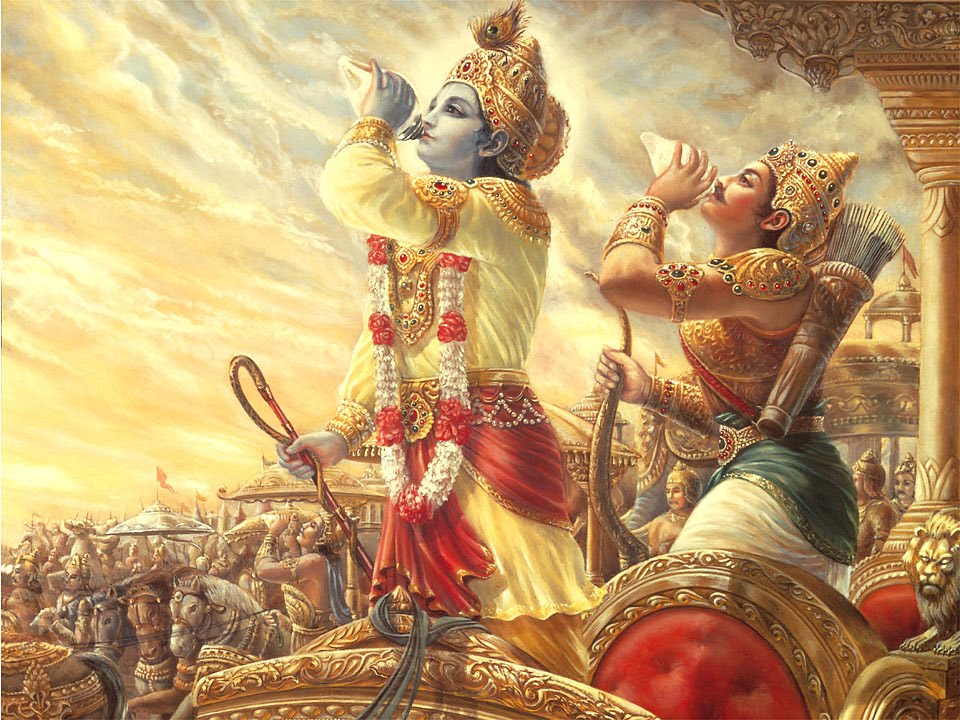
Cousin and friend, now acting as charioteer, Shri Krishna is asked by Arjuna to take him to the middle of the battleground so that he can look in the eyes of the enemy who have come here to be killed by him. It seems as if on purpose Shri Krishna stations him right in front of Arjuna’s beloved great grandfather Bhisma. Arjuna, who was clear in his mind that his opposition has assembled only to be wiped out by his arrows identifies his enemies as relatives now, Raaga (attachment) begins to unfold.

Arjuna, who knew very clearly that all options of averting the war have been exhausted and people have chosen their sides for the battle thereby he is looking at the enemy camp, yet keeps on dwelling on the thought that these are my relatives after all. This causes Moha, delusion, and he starts arguing with Krishna why they are in the wrong place and should abandon the post. Tendulkar doesn’t want to bat in the world cup final or Federer doesn’t feel like serving in the Wimbledon final!

Unchecked attachment leads to delusion which has just one destination and that is where Arjuna lands up. He is visibly distraught, feeling feverish, sweaty palms, shaky legs, dried mouth as if strong bouts of GERD are hitting him. Such is the state of the super-star who has lost clarity of his Dharma due to Raaga and Moha, and has become Despondent Arjuna – Arjuna in Vishaad.